Build-Ready Sites
Hand over a completely cleared, level, and unobstructed ground footprint to your earthmovers and builders.
Efficient block clearing, site preparation, and invasive scrub management across Lakes Creek acreage and residential lots.
Servicing Lakes Creek, Port Curtis, Koongal, Parkhurst, and Gracemere.
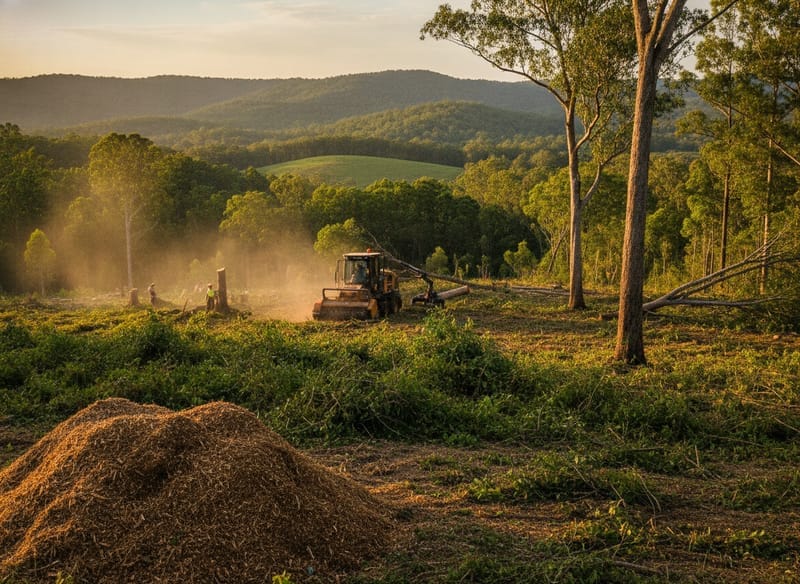
Preparing a block for a new home, agricultural fencing, or bushfire protection requires capable equipment and an understanding of local vegetation. Our land clearing Lakes Creek service provides comprehensive block clearing, paddock recovery, and scrub mulching across all property sizes.
Lakes Creek includes larger acreage blocks running towards the foothills and river flats that frequently become overrun with dense Leucaena, lantana, and African Tulip trees. We clear this heavy woody biomass efficiently while respecting mapped waterway buffer zones.
Hand over a completely cleared, level, and unobstructed ground footprint to your earthmovers and builders.
Lower fire risks by creating clear fire breaks and reducing ladder fuels around residential dwellings and outbuildings.
Reclaim overgrown grazing land choked by invasive woody weeds and scrub, returning it to productive use.
We review property boundaries, check RockePlan overlays, and identify trees to be retained.
Our team delivers the appropriate combination of excavators, track loaders, and mulchers to your site.
We fell large designated trees, mulch understorey scrub, and clear along pegged building envelopes or fence lines.
Stumps are ground or excavated, and green waste is mulched into the soil or consolidated for removal.
At Rockhampton Arborist, we provide the professional Land Clearing Lakes Creek residents, acreage owners, and builders rely on for safe, compliant, and efficient site preparation. Situated right on the Fitzroy River flood plain, properties in this area face unique environmental challenges, especially following the major floods of January 2026 triggered by ex-Tropical Cyclone Koji. Whether you are clearing waterlogged, unstable vegetation along a property boundary, preparing a residential block for a new shed, or establishing an Asset Protection Zone, our local team is equipped to handle the heavy lifting.
We understand Rockhampton's dry tropics climate, the heavily saturated soils that follow the wet season, and the specific planning requirements of the Rockhampton Regional Council. From selectively removing leaning Forest Red Gums and managing declared weeds, to clearing thick undergrowth and storm debris, our climbers and ground crews deliver a clean, workable site. We take a careful, arborist-led approach to clearing, strictly protecting the mature trees you want to retain while efficiently processing the vegetation that needs to go.
Do-it-yourself or under-qualified land clearing goes wrong quickly, often leading to costly property damage or severe legal penalties. Bringing heavy earthmoving machinery onto the wet flood plains of Lakes Creek causes severe soil compaction, deep rutting, and irreparably damages the Structural Root Zones (SRZ) of retained canopy trees like mature Raintrees or Moreton Bay Figs. Furthermore, untrained operators frequently ignore Rockhampton's Biodiversity areas overlay or the state Vegetation Management Act 1999, which can result in massive fines for illegal clearing.
Indiscriminate bulldozing tears roots, leaves messy, hazardous sites, and often involves the illegal "lopping" or "topping" of retained trees. This poor pruning promotes weak epicormic regrowth that is virtually guaranteed to fail in the next dry-tropics thunderstorm.
Our solution focuses on targeted, arborist-led clearing. We assess the site first, checking the RockePlan tool to ensure you are clear of overlays, or helping you navigate the current disaster clearing exemption (active until January 2027) for hazard reduction. By combining AQF Level 3 climbing skills with precision ground machinery like skid steers and 12-inch wood chippers, we dismantle unwanted vegetation cleanly. Retained trees are protected under strict AS4970 guidelines, ensuring your site is prepared safely, legally, and sustainably.
We utilise a structured, machinery-assisted approach to site clearing, tailored to the specific terrain and vegetation of the Fitzroy flood plain and surrounding Rockhampton acreage.
Before cutting, we review the Rockhampton Region Planning Scheme via RockePlan, checking for Biodiversity or Heritage overlays. We identify retained native species like Leichhardt Trees and ensure state Vegetation Management Act 1999 compliance.
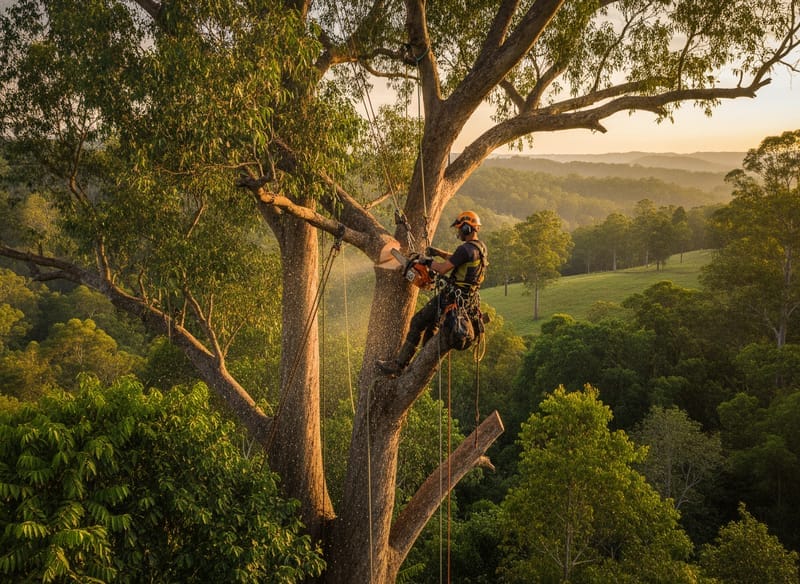
For properties retaining a mature canopy, we use directional felling and heavy-duty ground saws (Stihl MS500i, 572XP) to surgically remove scrub, saplings, and hazardous trees without damaging the retained stock's Tree Protection Zone (TPZ).
For sites approaching the Berserker foothills with bushfire overlays, we clear vegetation to meet AS3959 standards, managing fuel loads while maintaining soil stability and complying with local clearing thresholds.
Our heavy-duty 9-inch and 12-inch wood chippers process cleared limbs and underbrush directly on-site. The resulting mulch can be retained for soil health and erosion control, or loaded into our tipper trucks and removed.
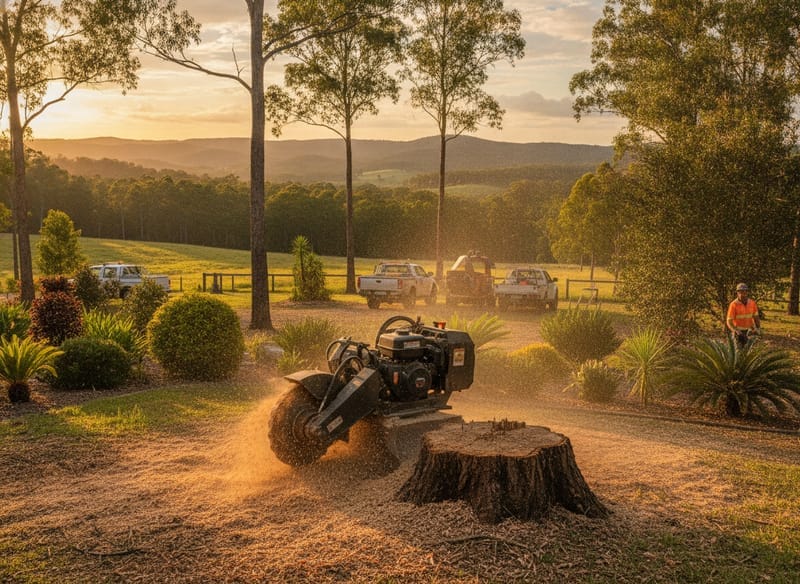
To provide a completely level site for construction or fencing, we use self-propelled stump grinders to mill stumps down to 150–300mm below natural ground level, preventing regrowth and removing trip hazards.
We follow a methodical, step-by-step process from the initial quote to the final site handover, ensuring every land clearing project is efficient, safe, and fully compliant with local regulations.
1. Initial Consultation & Mapping We meet you on-site in Lakes Creek to discuss your specific goals—whether it is clearing a footprint for a new build, opening up a fence line, or conducting post-flood cleanup. We identify exactly which trees stay and which go.
2. Compliance Verification Our team checks RockePlan for local overlays and verifies if your site falls under the current state disaster clearing exemption (running until 17 January 2027, following ex-TC Koji). If permits are required, we guide you through the Rockhampton Regional Council application process.
3. Site Establishment & Protection On the day of the job, we establish safe staging areas for our trucks and chippers. We explicitly mark out Tree Protection Zones (TPZ) for any mature shade trees being retained, preventing machinery damage to their root systems.
4. Execution & Processing Our arborists selectively dismantle the targeted vegetation using chainsaws and machinery. We process the timber as we go, chipping the scrub into mulch and loading the heavy logs into our tipper trucks for removal.
5. Final Cleanup & Handover We rake the site, ensure all agreed stumps are ground to specification, and leave your property bare, clean, and ready for your builders, fencers, or landscapers.
Land clearing is high-risk work that requires strict adherence to Australian Standards. Our operations comply with AS4970 (Protection of Trees on Development Sites) to safeguard your retained canopy, and AS4373 (Pruning of Amenity Trees) for any necessary canopy modification. Our business is fully insured with comprehensive Public Liability and WorkCover for all employees, giving you complete peace of mind.
Our crews hold AQF Level 3 in Arboriculture, alongside current Working at Heights, Chainsaw, and First Aid tickets. For complex development applications in Lakes Creek requiring council approval, our AQF Level 5 consulting arborist can provide the necessary formal reports.
Lakes Creek is a unique pocket of Rockhampton. Bound by the Fitzroy River to the south and sloping up toward the Berserker Range to the north, properties here deal with two extreme hazard drivers: riverine flooding and dry-tropics storm seasons. After the January 2026 floods, the waterlogged ground left many large trees leaning and unstable, creating an urgent need for hazard clearing across the suburb. Because there is no blanket tree preservation order in Rockhampton, clearing rules depend entirely on your specific lot. Properties near the water may trigger the Biodiversity areas overlay or state Fisheries Act protections for marine plants. Our team is deeply familiar with the local canopy, from managing fast-growing declared pests like Leucaena and African Tulip, to safely working around significant native species like Narrow-leaved Ironbark and Moreton Bay Ash. When you book a Land Clearing Lakes Creek service with us, you are hiring locals who know exactly how to manage this specific terrain legally and safely.
Once the land clearing is complete, proper site management is essential. In the dry tropics, exposed soil can quickly erode or invite invasive weeds. If we have left mulch on-site, we recommend spreading it evenly to retain soil moisture and suppress the germination of nuisance species like Leucaena. Keep a close eye on any retained trees; sudden exposure to full sun and wind can sometimes cause transplant shock or minor limb drop. We recommend scheduling a follow-up assessment of your retained canopy within 12 months, or after a severe storm. If you notice structural changes or deadwood in your remaining trees, call our team for a professional inspection.
Land clearing costs in Lakes Creek are influenced by block acreage, vegetation density, machinery requirements, and terrain.
We conduct detailed on-site property walkthroughs to provide clear, transparent quotes with set project scopes.
We provide comprehensive land clearing across Lakes Creek and surrounding rural-residential districts:
Contact our team for an on-site property walkthrough and transparent project quote on all block clearing works.
Book a Land Clearing Quote